
Breaking Down the ANSI/ASSP Z359.14-2021 Standard Update for Self-Retracting Devices: What’s Changed and Why it Matters
- Mar 12, 2026, 03:15 PM
-
This blog article was taken from on the 3M ANSI/ASSP Z359.14-2021 Standards Update Summary Technical Bulletin published in January 2022, and can be viewed here. It is republished with permission.
Description
On June 17, 2021, the American National Standard for the Safety Requirements for Self-Retracting Devices (SRDs) was approved with an effective date of August 01, 2023. After which, manufacturers are required to conform to this latest revision of the ANSI/ASSP Z359.14 standard document. The requirements of this revised standard
supersede any corresponding requirements in ANSI/ASSP Z359.14-2014, ANSI/ASSP Z359.1, ANSI/ASSP Z359.3 and ANSI/ASSP Z359.4 American National Standards.
The information contained in this summary is derived from 3M Fall Protection’s review and interpretation and is not intended to be a substitute for reading the official ANSI/ASSP Z359.14-2021 document in its entirety. This standard applies to all SRDs used in occupations requiring personal protection against falls from heights and, if required, shall allow for the specialized functions of travel restraint, rescue and or retrieval.
Historical Timeline of the Product Standards and Regulatory Requirements Addressing Full Body Safety Harnesses Used in Personal Fall Protection Systems
- ANSI Z359.1 first provided performance guidance on fall protection equipment in May 1992. This document included language on self-retracting devices.
- ANSI Z359.1 was reaffirmed in 1999.
- January 2012, ANSI Z359.14 was published defining the Safety Requirements for Self-Retracting Devices becoming effective August 20, 2012. Leading Edge and Class A and B devices were first established.
- September 17, 2014, ANSI Z359.14-2012 was revised and published in February 2015 defining the Safety Requirements for Self-Retracting Devices under ANSI/ASSP Z359.14-2014. Additional information regarding leading edge devices was included. June 17, 2021, a revision of ANSI/ASSP Z359.14 was published defining the Safety Requirements for Self-Retracting Devices with an effective date of August 01, 2023 for manufacturers to comply.
Overview of Notable Changes between the Previous 2014 and New 2021 Revisions within ANSI/ASSP Z359.14 Standard
- New: ANSI/ASSP Z359.14 test mass has increased to 310 pounds (140kg) Previous Revision: 282 pounds (128kg).
- Updated: SRL categories have been designated:
- SRL
- SRL-P (New) for Personal SRL
- SRL-R (Carry over from previous revision)
- SRL-LE has been removed and will now be designated under Class 2
- Updated: SRD Classifications revised:
- Class 1 SRD – For use with anchorages AT or ABOVE the dorsal D-ring. Maximum allowable freefall not to exceed 2 feet
- Class 2 SRD – For use with anchorages ABOVE or BELOW the dorsal D-ring. Maximum allowable freefall not to exceed 6 feet (1.8m)
- Updated: Webbing and Synthetic Rope used in Class 2 devices must now have a minimum tensile breaking strength of 5,000 pounds (22.2kN).
Previous Revision: 2014 revision this was 4,500 pounds (20kN). - New: Class 2 devices are now required to have an integral energy absorber on the lifeline. This energy absorber must meet all of the ANSI/ASSP Z359.14 testing requirements or independently meet the ANSI/ASSP Z359.13 requirements. For SRL-P devices where the device attaches to the users dorsal D-ring instead of the anchorage, no energy absorber is required on the lifeline. The SRD must provide some means to dissipate the arresting forces.
- Updated: Static Strength Test – All SRDs must be capable of withstanding a 3,600 pound (16kN) static load for one minute with the lifeline constituent fully extracted. Previous Revision: 2014 revision was a 3,000 pound (13.3kN) static test.
- New: SRDs that do not incorporate an internal braking system must hold a minimum 1,800 pound (8kN) static load while the brake pawls or other brake activation system is engaged and locked with at least 75% of the lifeline constituent remaining on the drum assembly.
- New: SRL-P devices with twin or dual legs must hold a 3,600-pound (16kN) load applied from leg to leg.
- New: SRL-P devices designed to wrap around an anchorage or tie back onto themselves must hold a load of 3,600 pounds (16kN) applied after completion of 2,500 cycles of abrasion testing with the lifeline constituent wrapped around a testing I-beam fixture.
- New: SRL-P and Class 2 devices DO NOT need to retract after the overhead dynamic performance tests.
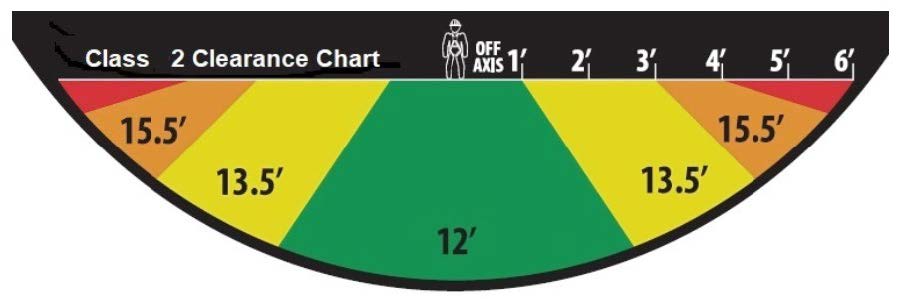
- New: Class 2 SRL-P devices shall include a clearance requirement label.
- Updated: During ambient dynamic performance testing utilizing a 310-pound (140kg) test mass, the average arresting force (AAF) allowed has been increased from 900 (4kN) to 1350 (6kN) pounds and the arrest distance (AD) has been shortened to 42 inches (1,067mm). For the conditioning tests, AAF remains at 1575 pounds (7kN), but the AD is now 42 inches (1,067mm). Previous Revision: Both ADs are down from 54 inches (1,372mm) with conditioning temperatures and times remaining same as previous.
- New: SRL-P devices must pass a dynamic performance test with a 310-pound (140kg) weight and a 6 foot (1.8m) free fall and keep the MAF at 1800 pounds (8kN) or less. (lifeline does not get pinned or restrained to prevent retraction).
- New: Class 2 SRD must pass a dynamic test over an edge with a 310 (140kg) pound weight and the AAF must not exceed 1350 pounds (6kN) and MAF not exceed 1800 pounds (8kN) ambient and AAF 1575 pounds (7kN) conditioned.
- New: SRL-R function tests are the same but static testing when in retrieval mode is now 3600 pounds (16kN).
- New: SRLs with internal brakes must pass a test with the lifeline shortened to 42 inches (1,067mm), then have 36 inches (914mm) +/- 1.0-inch (25mm) clipped out, then have a 310-pound (140kg) weight free falling 2 feet (.6m) and must maintain MAF at 1800 pounds (8kN) or less.
- Updated: SRL-P and Class 2 devices can only have up to 48 inches (1,219mm) of line outside the SRL housing when fully retracted.
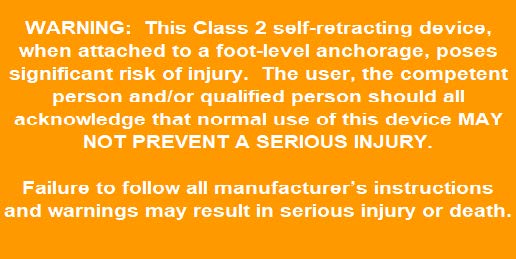
Previous Revision: 60 inches (1.5m). - New: Warning card is required to be provided as a separate card insert with each SRD.
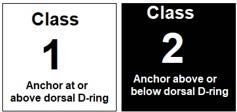
Class Designation Icons
Previous Revision: 2014 revision designated Class A and B devices.
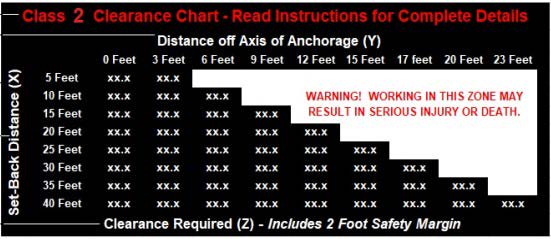
CLASS 2 Integral Clearance Chart Example
As stated previously, all SRD products manufactured after February 1, 2023 and claiming compliance to ANSI/ASSP Z359.14 will be required to conform to the most current revision of the document. Products manufactured to previous revisions of the ANSI Z359.14 standard may continue to be used as long as the product continues to meet the inspection requirements as defined by the manufacturer, conducted at the recommended intervals by a Competent Person.